For Teams
Send a team.
Build the capability.
Your team completes this programme. You bid on contracts you currently cannot bid on.
First authorised delivery of MIT 2.017 and MIT 2.680 outside MIT.
Why 2026
HCDI 2026 funding calls create a concrete deadline: organisations must demonstrate marine autonomy engineering capability before the procurement window closes. EDF programmes and NATO maritime autonomy requirements add parallel pressure. Organisations that complete Triton before the end of the 2026 HCDI cycle will have documented, MIT-certified capability to reference in proposals. The organisations that don't will not.
Who this is for
Seven organisational profiles that benefit directly.
-
Defence primes and specialised defence SMEs
Builds the engineering capability required for USV and UUV programme development, HCDI R&D calls, and autonomous maritime systems procurement and integration.
-
Maritime systems integrators
Adds in-house USV design and autonomy software capability to your service offering; skills directly transferable to UUV and larger platform programmes.
-
Offshore energy and marine infrastructure
Prepares engineering teams for the shift to autonomous inspection, survey, and monitoring.
-
Marine technology start-ups
Accelerates your team's technical foundation and opens MIT and regional network doors.
-
Ocean science, environmental and aquaculture
Enables in-house USV capability for data collection, monitoring, and field operations.
-
R&D divisions of shipping and port companies
Develops the technical staff who will evaluate and specify autonomous maritime procurement.
-
South-East European universities
Provides engineering faculty with cutting-edge curriculum and research contacts at MIT.
What your organisation gets
Capability, not credentials
The programme produces engineers who have designed, built, programmed, and field-operated autonomous surface vehicles. The MOOS-IvP autonomy software skills they acquire are platform-transferable — directly applicable to UUV programmes and larger autonomous platforms. The certificate documents a real capability, not course attendance.
Strengthening the proposal case
HCDI and EDF proposals that can cite MIT-certified marine autonomy training by specific engineers, with documented lab results, carry measurably more technical weight.
Strategic timing
This is the first and only authorised delivery of this curriculum outside MIT. The organisations that train in 2026 enter the next procurement cycle with a verifiable lead.
Team depth, not single individuals
Sending two to five engineers creates an internal community of practice. A single individual becomes a single point of failure. A team becomes a capability.
What teams take home
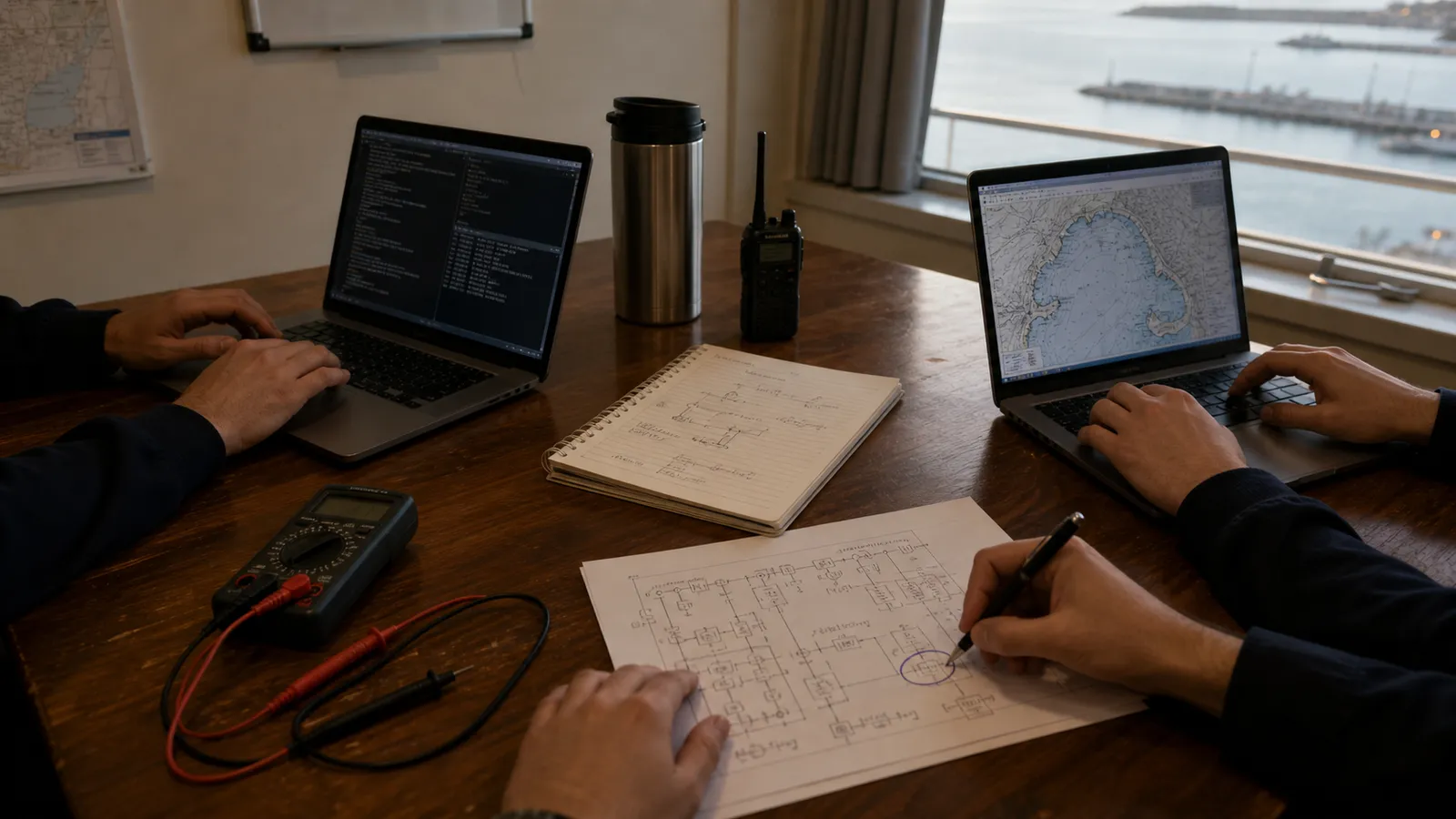
- Working code — mission scripts, autonomy behaviours, sensor integration — written by your own engineers under MIT instruction.
- Working hardware configurations for an autonomous surface vessel — sensors, actuators, and control systems applicable to USV and UUV platforms.
- Engineering-grade lab notebooks suitable for technical proposal annexes.
- MOOS-IvP proficiency, including multi-vehicle coordination (Marine Autonomy).
- In-water autonomous mission experience, including competitive multi-vehicle operations.
- MIT Open Learning certificate per course, per participant.
Pricing
Pricing is tiered and scales with the number of seats. Volume pricing is available for organisations sending more than ten participants per course; standard pricing applies between three and ten seats; individual pricing applies below three. Pricing details and the formal seat-enrolment agreement are provided on request.